

 The TechQuilt
 The Cosmic Mystery Solved, How Supermassive Black Holes Actively Kill Star Formation
Introduction: The Ultimate Cosmic Paradox
Imagine a giant in the middle of a city, so powerful that its simple presence stops every baby from being born. That’s the stunning reality astronomers are now confirming in space. At the heart of nearly every large galaxy, including our own Milky Way, sits a monster, a supermassive black hole. While these behemoths are famous for eating matter, a new study reveals their most profound action, they are actually star killers, actively suppressing the birth of new stars across their host galaxies.
This isn’t just a quirky space fact, it’s a crucial piece of the puzzle that explains why some galaxies are bright and buzzing with new stars, while others are mysteriously quiet. If you’ve ever wondered how galaxies age and change, the answer lies with these powerful, enigmatic objects. Read on to discover the mechanism that turns a cosmic vacuum cleaner into a cosmic fan, and how this process governs all of galaxy evolution.
The Secret Life of Black Holes, From Eater to Heater
The relationship between a central supermassive black hole and its galaxy is not a simple love story, it’s a constant cosmic battle. For a galaxy to form stars, it needs huge clouds of cold gas and dust. Think of this cold gas as the “baby food” for stars, stars are born when these cold clouds collapse under their own gravitational pull.
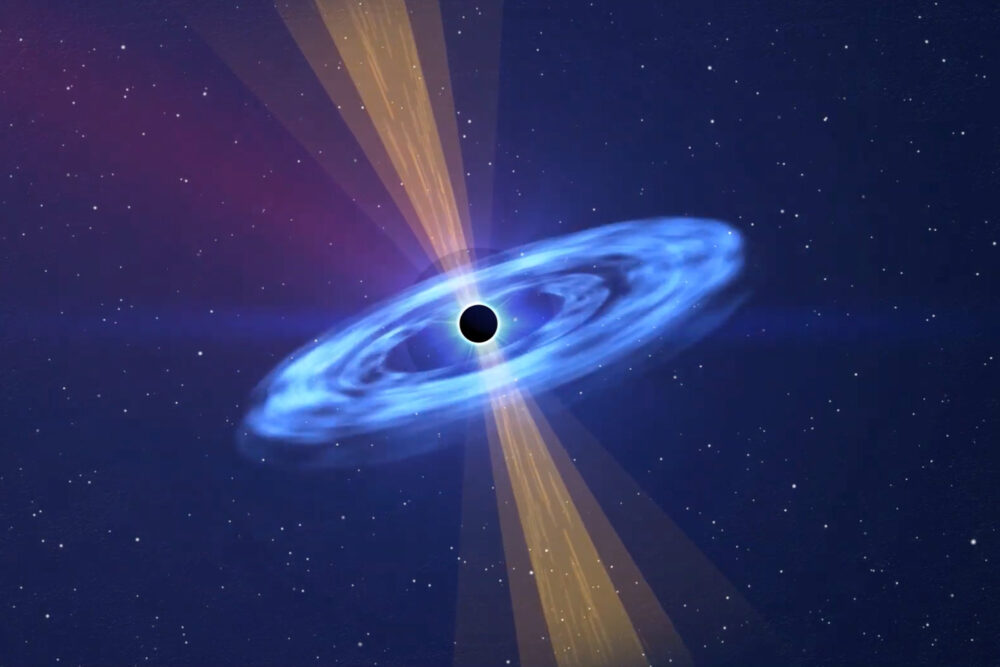
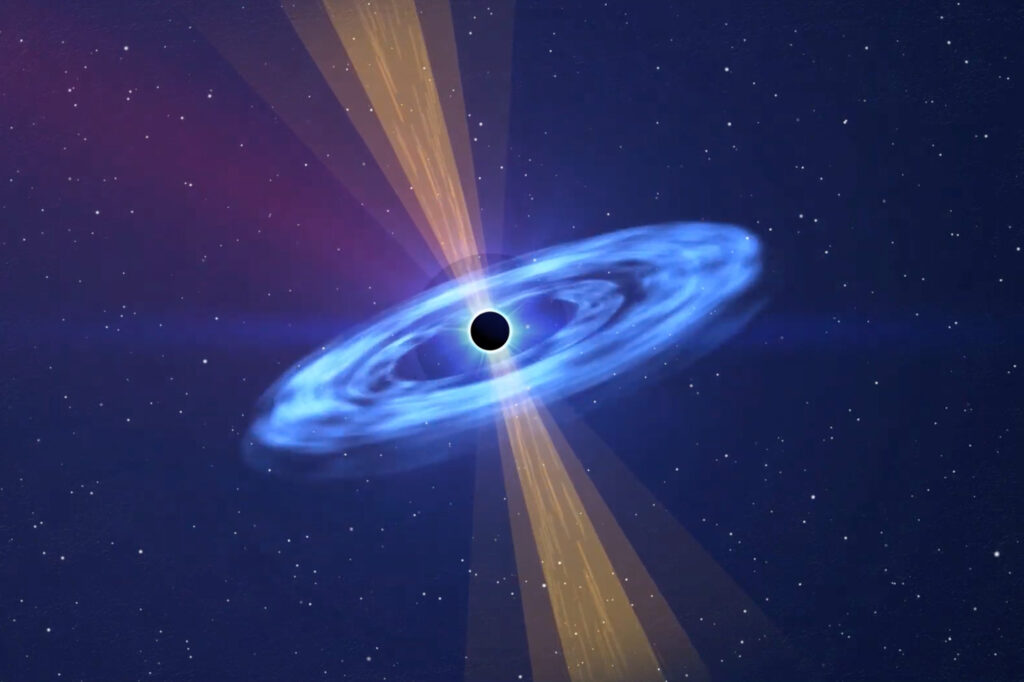
Here is where the black hole steps in. When matter, like gas and dust, spirals into the black hole, it forms an incredibly hot, fast-spinning structure called an accretion disk. This process releases an enormous amount of energy, often blasting out powerful streams of radiation and particles, known as “jets,” perpendicular to the disk.
This energy release is called Black Hole Feedback, and it works in two ways:
- The Cosmic Fan: The jets and powerful winds act like a gigantic, high-speed fan, literally blowing away the cold gas needed for star formation out of the galaxy.
- The Cosmic Heater: The energy from the black hole heats the surrounding gas to extreme temperatures. When gas is super-hot, it can’t collapse to form new stars. The black hole essentially heats the “baby food,” making it impossible for stellar nurseries to grow.
In short, the black hole doesn’t have to eat everything to stop star formation, it just has to heat and scatter the raw materials. This is the crucial finding in understanding the vast, interconnected structures known as the cosmic web.
The IIA Study, Confirming the Galactic Shutdown
A groundbreaking study by astronomers from the Indian Institute of Astrophysics (IIA) has provided strong evidence confirming this galactic shutdown process. By observing galaxies, they were able to directly link the activity level of the central black hole, how much material it’s consuming, with the sharp decline in star birth rates within that galaxy.
The team’s work confirms that powerful supermassive black holes play a dominant and deciding role in the lifecycle of a galaxy. It’s not just a passive object sitting in the center, it’s the CEO of its galaxy’s evolution.
This discovery helps resolve a long-standing mystery in astrophysics, why we see so many “dead” or quiescent galaxies, those that are no longer forming new stars. These galaxies are likely the victims of their own overly active central black holes, which have successfully cleared out or heated up their entire gas supply, thus stopping star production cold. This observation is vital for future missions, including research using the James Webb Space Telescope, to understand galaxy formation in the early universe.
Conclusion: The Architects of the Universe
The study of supermassive black holes and their effect on star formation is more than just academic curiosity, it defines the very architecture of the universe. We now know that the existence and evolution of a galaxy, its size, color, and stellar population, are all critically dependent on the temper and appetite of the monster residing at its core.
The next time you look up at the night sky, remember that the beautiful galaxies you see are in a constant, delicate balance. They are fighting a silent, powerful war against the ultimate source of gravitational pull, a war where the black hole determines who lives, and who dies, in the process of galaxy evolution.
This revolutionary insight confirms the complex feedback loop that links the smallest of cosmic structures, like gas clouds, to the most massive, like supermassive black holes, painting a vivid picture of a dynamic, ever-changing cosmos.

 Avik Roy Chowdhury