
 The TechQuilt
 The Universe May Not Be Endless: Why Scientists Now Predict a Shocking “Big Crunch”
For decades, we have looked up at the night sky with a comforting thought. We believed the universe would go on forever. We thought it would keep expanding until everything faded into a cold, dark silence. But a new discovery has shattered that belief. It turns out that the cosmos might not end in a whimper after all. Instead, it could end in a violent, fiery collapse known as the Big Crunch.
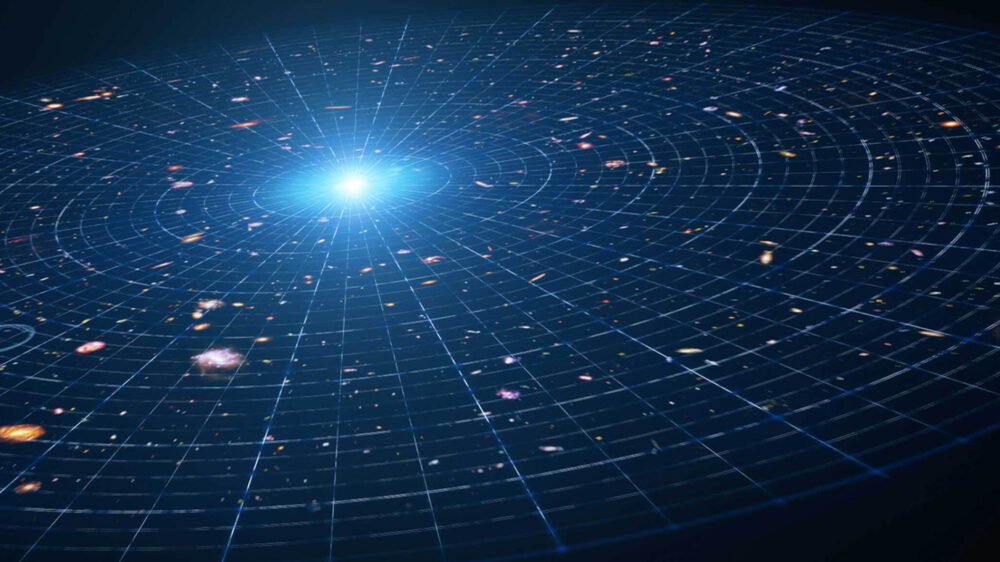
Imagine a ball thrown into the air. Usually, we expect it to fall back down because of gravity. But for the last twenty years, astronomers told us the universe was like a ball attached to a rocket. They said a mysterious force called “dark energy” was pushing everything apart faster and faster. They were sure this expansion would never stop. Now, however, that certainty is crumbling.

The Shocking New Data
A team of astronomers from South Korea has dropped a bombshell on the scientific community. They revisited the data that first proved the existence of dark energy, and what they found is terrifyingly simple. They discovered evidence that this invisible force is not as constant as we thought. In fact, it seems to be losing its strength.
This changes everything. If dark energy runs out of fuel, it can no longer fight against gravity. Think of it like a tug of war. On one side, you have dark energy pushing galaxies away. On the other side, you have gravity trying to pull them back together. If dark energy gets weaker, gravity wins. The expansion of the universe would slow down, stop, and then reverse.
What Is the Big Crunch?
The Big Crunch is exactly what it sounds like. It is the Big Bang played in reverse. If this theory holds true, the universe will not fade away. It will crash back into itself.
First, we would see the changes in the sky. Distant galaxies that were rushing away from us would hit the brakes. Then, they would start moving toward us. Slowly at first, and then faster and faster.
As the universe shrinks, things would get crowded. Galaxies would smash into each other. Stars would collide. The empty space that keeps us safe would disappear. But the most frightening part is the heat.
Right now, the space between stars is freezing cold. In a shrinking universe, that background radiation would heat up. It would turn from a faint glow into a blazing oven. The temperature would rise to thousands of degrees. Eventually, everything—every star, every planet, every atom—would be crushed into a single, unimaginably hot point. It would be a fiery end to everything we know.
Why Is This Happening Now?
The debate heated up after new observations from the Dark Energy Spectroscopic Instrument, or DESI. This massive machine in Arizona maps millions of galaxies to see how the universe has changed over time. The data hinted that dark energy is not a steady force. It fluctuates.
Professor Young Wook Lee from Yonsei University led the new study. He suggests that our previous calculations were slightly wrong because we assumed all supernovas (exploding stars) looked the same. By correcting for the age of the galaxies, his team found that the universe’s acceleration might already be slowing down.
“The fate of the universe will change,” Professor Lee stated. He believes we need to prepare for a different ending.
Is It Certain?
Not every scientist agrees yet. The idea of a collapsing universe is controversial. Some experts argue that the data is too messy to be sure. They say we need more proof before we rewrite the laws of physics. However, even the skeptics admit that a Big Crunch is now a real possibility. We can no longer rule it out.
Conclusion
We used to think the universe was a one way street to emptiness. Now, we are realizing it might be a cycle. The concept of scientists warning the universe could collapse forces us to rethink our place in the cosmos. While this fiery end is still billions of years away, it reminds us that nothing lasts forever. Not even the universe itself. We are just living in a brief, lucky moment of expansion before the great collapse begins.